


Fuel Cell Hydrogen Storage System
Hangzhou Impact New Materials: a Professional Fuel Cell Hydrogen Storage System Supplier
With the mission of accelerating the industrialization of fuel cells, our company is committed to promoting the development of hydrogen energy and fuel cell industries.
Professional Team
Our company brings together the backbone of the fuel cell field at home and abroad. The core R&D team comes from professional backgrounds such as "fuel cell + mass production vehicle" and has senior experience in the development and application of fuel cell stacks, fuel cell systems, and complete vehicles.
Variety of Products
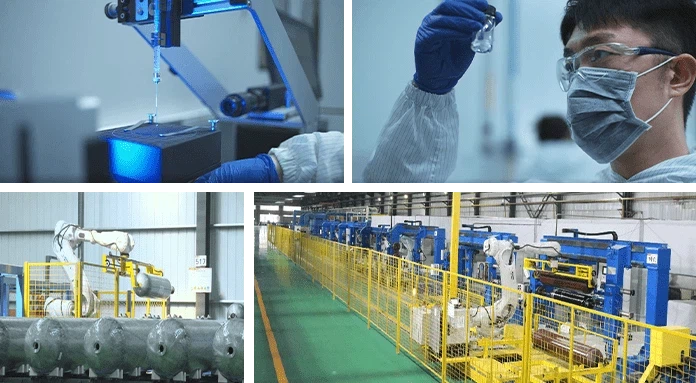
Our new park has four major functions: R&D office, testing and verification, production and manufacturing, and hydrogen supply. The production line covers a full range of products such as membrane electrodes, fuel cell stacks, fuel cell systems, and hydrogen storage systems.
Multi-Field Practice
Our company has completed the product development of various fuel cell stacks and fuel cell systems with power ranging from 6kW to 260kW. These products are widely used in passenger cars, city buses, highway buses, light, medium and heavy trucks, forklifts, trailers and many other fields, and can be extended to distributed power generation, combined heat and power, ships, aviation and other fields.
Multiple International Certifications
Our company has obtained ISO 13485 quality system certification and CE certification of TUV Rheinland. We have also passed FDA registration and BSCI audit. In addition, our products have been sold to more than 60 countries and regions, and they have been inspected by many customers.


Hydrogen storage is a key technology driving the advancement of hydrogen and fuel cell technology in applications such as stationary power, portable power and transportation. Hydrogen has the highest energy per unit mass of all fuels. However, its lower ambient temperature density results in lower energy per unit volume, necessitating the development of advanced storage methods with the potential for higher energy density. Fuel cell hydrogen storage systems, usually high-pressure tanks, are designed for this purpose. It can store hydrogen in gas or liquid form.

Features of Fuel Cell Hydrogen Storage System
Sealing
The first requirement for any hydrogen tank is to safely retain all the hydrogen stored in it and only release the hydrogen under controlled, safe conditions. Manufacturers can help you create a fuel cell hydrogen storage system suitable for your application by providing materials with the right combination of tensile strength and hydrogen resistance required.
Compact Structure
Fuel cell hydrogen storage systems do not take up much additional space because the tanks are very compact. Additionally, these tanks are relatively light. The storage tank is an important part of any application using hydrogen and therefore has a considerable weight impact on the overall system.
High Fatigue Resistance
These hydrogen storage tanks can be filled, emptied and refilled multiple times. Executing this sequence is called a loop. Generally speaking, the more cycles a jar can withstand, the longer its expected lifespan. In addition, their material effectively prevents embrittlement caused by hydrogen.
Reliable Welding
Manufacturers typically make these fuel cell hydrogen storage systems using welding procedures that are proven to be hydrogen resistant in the same fracture mechanics tests as the base material. This ensures clean and reliable welds, so the tanks are structurally strong.
Products Description
Convenience
Hydrogen has a high gravimetric energy density and can store more energy in a smaller, lighter package than batteries. Therefore, fuel cell hydrogen storage systems are well suited for storing hydrogen and are an attractive energy storage option.
Long Term Storage
Unlike batteries, which lose charge over time, hydrogen can be stored indefinitely without significant energy loss. Therefore, fuel cell hydrogen storage systems become an ideal solution for long-term energy storage and seasonal energy balancing.
Scalability
Fuel cell hydrogen storage systems can be designed in different sizes and specifications to meet the needs of a variety of applications from small residential systems to large-scale grid storage.
Maintain Grid Stability
Fuel cell hydrogen storage systems can help stabilize the grid by providing a buffer between supply and demand, reducing the need for peaking power plants and improving the overall efficiency of the grid.
Environmental Friendly
Hydrogen can be obtained by electrolysis of electricity generated from surplus renewable energy sources, while enabling hydrogen to meet corresponding energy needs. This recycled hydrogen can be stored in large quantities over a long period of time using a fuel cell hydrogen storage system, which can then be used as backup energy when needed.
Safety
The fuel cell hydrogen storage system undergoes rigorous testing for leaks and other potential issues to ensure it can safely store and distribute hydrogen. It can improve safety and build confidence in hydrogen as a safe, clean and renewable fuel for the future.
Types of Fuel Cell Hydrogen Storage System
There are five types of hydrogen storage tanks that can be used for both stationary and mobile applications to store hydrogen.
Type 1
This is the most common gas tank, which is a simple cylinder made of steel. The operating pressure is from 200 to 300 bar, and it is typically used for industrial applications. The density of such a type 1 storage is around 15 grams per liter.
Type 2
This type of tank is an improvement over type 1, as it has additional fiberglass reinforcement on the outside, which increases its stability and allows gas storage at a higher pressure. The operating pressure for this tank is typically 100 to 500 bars, and it is mainly used in industrial applications. The density of hydrogen in a type 2 tank is around 20 grams per liter.
Type 3
This is where the interesting tanks for hydrogen begin. The inner liner of this tank is made of aluminum, and it is often found in vehicles. Type 3 tanks can store hydrogen at pressures up to 350 bar, and the typical density is 25 grams per liter.
Type 4
This type of tank is a further development of the type 3 tank, with a plastic bladder inside to seal off the hydrogen. This allows for greater expansion than the aluminum liner and enables the tank to contain a higher pressure of hydrogen, leading to a higher density, typically around 40 grams per liter at an operating pressure of up to 875 bar. Type 4 tanks are commonly used in the passenger car and heavy-duty commercial vehicle sectors.
Type 5
This is the most exotic type of hydrogen storage tank and has no inside bladder, polyamide, or aluminum. The matrix that makes the gas seal is the only component, which presents a significant challenge with hydrogen as it can migrate through even the dense matrices. The density of hydrogen in a type 5 tank is around 20 grams per liter.

Hydrogen storage tanks have a pressure range of 5,000 to 10,000 psi, depending on the tank type. However, there are some differences.
Type 1 – Estimated maximum pressure: 3,000 psi
Type 2 – Estimated maximum pressure: 4,340 psi
Type 3 – Estimated maximum pressure: 10,000 psi
Type 4 – Estimated maximum pressure: 10,000 psi
Type 5 – Estimated maximum pressure: 10,000 psi
Some Tips on Fuel Cell Hydrogen Storage System
Select the Appropriate Tank Material
Hydrogen adversely affects the mechanical properties of all materials. For example, it can cause metals to become brittle. This in turn leads to losses in tensile strength, ductility and fracture toughness and leads to accelerated fatigue crack growth. The extent of this deterioration depends on the material, the pressure and temperature of the hydrogen, and the mechanical load. This means that some materials are better than others. Ideally, materials for fuel cell hydrogen storage systems should be tested to ensure they function under expected operating conditions. Some commonly used materials include austenitic stainless steel, aluminum alloy, low alloy ferritic steel, C-Mn ferritic steel, copper alloy.
Choose the Best Location to Install the Hydrogen Storage Tank
When it comes to the safety of your hydrogen production unit, not only is it important to choose the right storage container, but also the best location to set it up. While it is possible to store small hydrogen bottles indoors, they are not recommended for larger volumes. Outdoor storage is generally safer, even if large quantities of hydrogen are stored, as this allows the gas to dissipate easily in the event of an accidental hydrogen leak. An optimal location needs to have the following characteristics: good ventilation, a safe distance from buildings and vents, protection from vehicle traffic or falling objects, no direct sunlight, and an ambient temperature that must not exceed 52 degrees Celsius. In addition, the location must be protected from unauthorized access.
Prevent Accumulation of Hydrogen Gas in Containers or Enclosures
As mentioned above, ventilation is extremely important when working with hydrogen. It ensures that the gas dissipates quickly and does not form potentially flammable mixtures with oxygen in the air. Since hydrogen is so light, this accumulation will certainly occur near the ceiling of a room or enclosure. This means appropriate overhead ventilation, detection and control measures are required. Additionally, since a hydrogen leak can never be ruled out, it is also important to install flame and/or gas detectors and the best fire suppression system possible. When H2 is released into the air environment, the gas will rise immediately with a speed of 10m/s. It is therefore necessary to detect the hydrogen concentration at the highest point in the room. In addition, you need to foresee the ventilation of the room: the air will be discharged from the highest points of the room.
Prevent Hydrogen Leakage
Leakage is a major problem for operations using hydrogen, as it is a small element and is responsible for a large proportion of accidents. One way to prevent this from happening is to install a leak detector and have it maintained and tested regularly. Regardless, leak testing should be performed regularly, including operational checks of the valve. Two popular testing methods are using a soap bubble solution or a handheld hydrogen detector. In addition to periodic testing, plant operators should check for leaks each time a joint is reassembled. In addition, connections to the fuel cell hydrogen storage system should be inspected for signs of corrosion, erosion, cracking, swelling, blistering, or any other form of deterioration.
Several of the Most Promising Hydrogen Storage Technologies
Hydrogen storage is one of the key challenges in realizing the full potential of hydrogen as a clean and sustainable energy carrier. There are many methods of hydrogen storage, each with its own advantages and limitations. The following content discusses advances and issues related to the most promising hydrogen storage methods.
Compressed Hydrogen Storage
Compressed hydrogen storage is one of the most common methods of hydrogen storage, where hydrogen is stored in high-pressure tanks. The main advantages of this method are its simplicity and reliability, as it does not require any complex or specialized equipment. However, compressed hydrogen storage has low energy density and is not suitable for long-distance transportation or large-scale energy storage applications. Additionally, the high-pressure tanks required for this method can be heavy and expensive, making it less practical for some applications.
Liquid Hydrogen Storage
Liquid hydrogen storage involves cooling the hydrogen to extremely low temperatures (-253 degrees Celsius) to liquefy it and storing it in insulated tanks. This approach has higher energy density than compressed gas storage, making it more suitable for long-distance transportation and space applications. However, liquid hydrogen has a low boiling point, is difficult to store and handle, and requires specialized and expensive equipment.
Metal Hydride Storage
Metal hydrides are solid materials that can absorb and release hydrogen through chemical reactions. This method has high energy density and can store hydrogen at lower pressures, making it a promising alternative for compressed gas storage. However, metal hydrides have limited hydrogen storage capabilities and are expensive to produce.
Carbon Nanotube Storage
Carbon nanotubes are tiny hollow carbon fibers that can store hydrogen through physical adsorption. This approach has the potential to achieve high hydrogen storage capacities and can store hydrogen at lower pressures than compressed gas storage. However, the current cost of producing carbon nanotubes is high, and there are challenges in controlling the adsorption and desorption of hydrogen in carbon nanotubes.
Chemical Hydrogen Storage
Chemical hydrogen storage involves using chemical reactions to store hydrogen gas in a stable form and release it when needed. This method has the potential to achieve high hydrogen storage capacity and can store hydrogen under ambient conditions. However, chemical hydrogen storage requires complex chemical reactions and specialized equipment, which is expensive and difficult to scale up.
Our Factory
The following are our factory:


Frequently Asked Questions